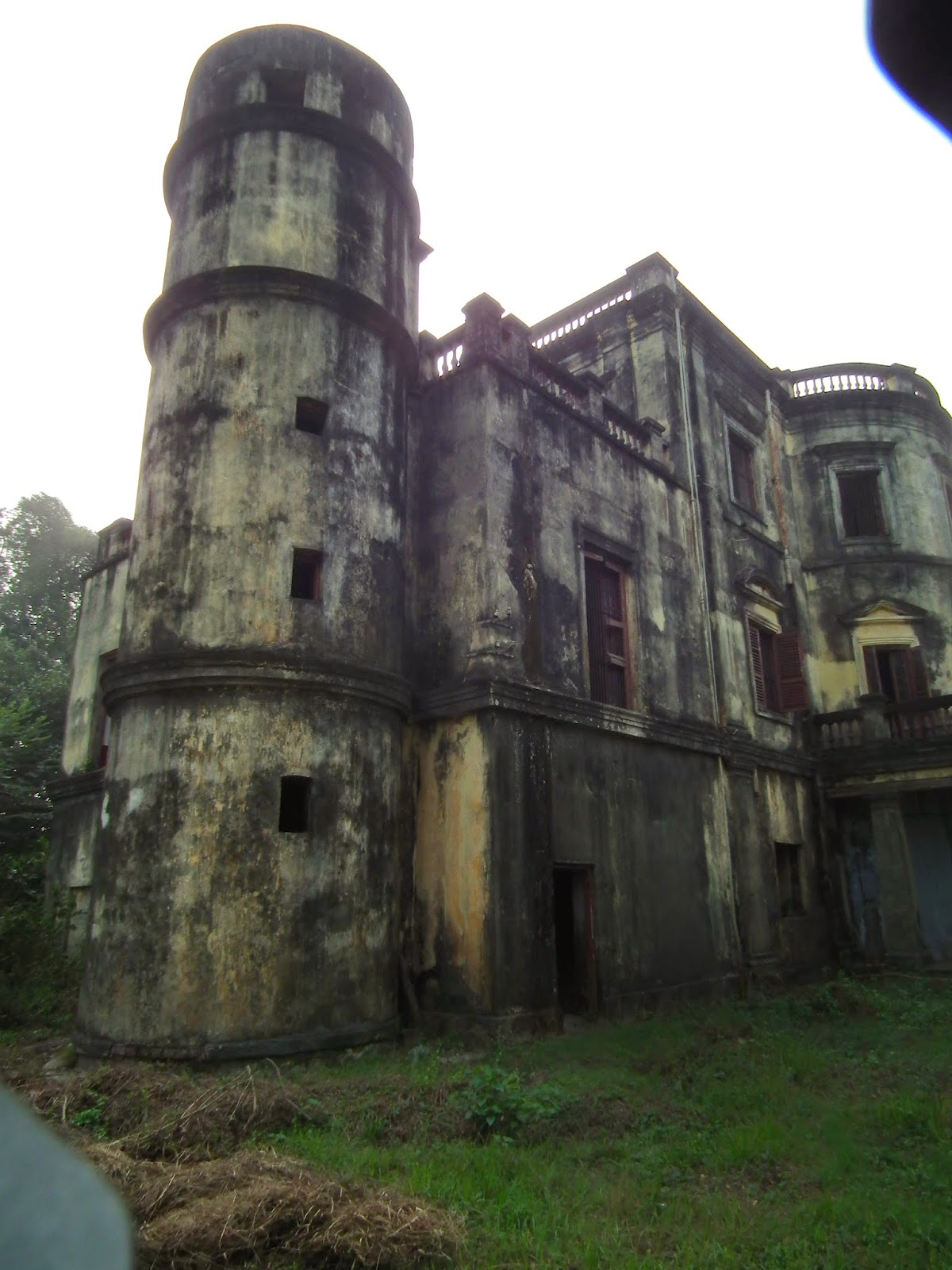
Metiabruz is
an epitaph to Wajid Ali Shah, the last Nawab of Awadh. Yet this hinterland of
Kolkata has today obliterated all memories of the deposed ruler who created a
beautiful and bustling township their after he was released from house arrest
by the British at Fort William. The echoes of the poetic names this colorful
ruler gave to places of worship, palaces and bungalows he constructed there in
the latter half of the 19th Century have died down. Only the large
Sibtainabad Imambara on Garden Reach Road (Now Nawab Wajid Ali Shah Road) and
Shahi Masjid, the Nawab’s personal chapel has survived.

Nawab Wajid
Ali Shah was the tenth and last Nawab of the state of Awadh in present day Uttar Pradesh in India.
He ascended the thorne of Awadh in 1847 and ruled for nine years. His Kingdom,
long protected by the British under treaty, was eventually annexed bloodlessly
on 11th February 1856- days before the ninth anniversary of his
coronation. The nawab was exiled to Garden Reach in Metiabruz, then a suburb of
Kolkata, where he lived out the rest of his life off a generous pension. He was
a poiet, playwrite, dancer and great patron of the arts. He was widely credited
with the revival of Katthak as a major form of classical Indian dance.


Wajid Ali
Shah succeeded to the throne of Awadh when its glory days were at its peak and
passing. The British had annexed much of the kingdom under the treaty of 1801,
and had impoverished Awadh by imposing a hugely expensive, British –run army
and repeated demands for loans. The independence of Awadh in name was tolerated
by the British only because they still needed a buffer state between their
presence in the East and South, and the remnants of the Mughal Empire to the
North.
Wajid Ali
Shah was most unfortunate to have ascended the throne of Awadh at a time when
the British East India Company has determined to grab the coveted throne of
prosperous Awadh, which was “the garden, granary and Queen-province of India”,
though before Britain come into full control, his predecessors and successors
were one of the major threats to the Mughal Empire.

In different
circumstances perhaps, he might have succeeded as a ruler because he had many
qualities that make a good administrator. He was generous, kind and compassionate
towards his subjects, besides being one of the most generous and passionate
patrons of the Fine Arts. When he ascended the throne, he took keen interest in
the administration of justice, introduced reforms, and reorganized the military
department. Wajid Ali Shah was widely regarded as a depraved and detached
ruler, but some of his disrepute seems to have been misplaced. The main case
for condemnation comes from the British Resident of Lucknow, General Sleeman
who submitted a report highlighting maladministration and lawlessness supposed
to be prevailing there. This proved to be the trigger the British were looking
for, and formed the official basis for their annexation. Recent studies have,
however, suggested that Awadh was neither as bankrupt nor as lawless as the
British had claimed. In fact, Awadh was for all practical purposes under British
rule well before the annexation, with the Nawab playing little more than a ostensible
role.


The army was
composed mostly of British officers, while the purse strings are firmly under
the control of the East India Company. In
his book “ Awadh under Wajid Ali Shah”, G. D. Bhatnagar gives the following
assessment of this unfortunate prince: “ Cast by providence for the role of an accomplished
dilettante, he found himself a misfit for the high office to which he was
elevated by chance. Wajjid Ali Shah’s character was complex. Though he was a
man of pleasure, he was a neither an unscrupulous knave nor a brainless
libertine. He was a lovable and generous gentleman. He was a voluptuary, still
he never touched wine, and though sunk in pleasure, he never missed his five
daily prayers. It was the literary and artistic attainments of Wajid Ali shah
which distinguished him from his contemporaries.”


Metiabruz of
today would have been an unknown place if Nawab Wajid Ali Shah wasn’t exiled
here. Metiabruz at present in Garden Reach, once used to be an isolated piece
of land adjacent to the Hoogly River. It was mainly used by the traders of East
India Company as their relaxation spot between their trade ventures by sea
route. It was only after 1856, when Nawab Wajid Ali Shah the then Nawab of
Awadh, Lucknow was exiled in Metiabruz by the British Government, this place
transformed dramatically. Metiabruz ment fort made from mud ( In Urdu matia
mean mud and bruz mean fort). Soon his royal house in Metiabruz started to
bustle with activity, Awadhi language, art, music, dance, singing, poetry,
smell of atar (fragrance made from flowers) are populist style of living.


If Kolkata, a
colonial city established by the profit seeking British has earned fame as the
countries cultural capital, it owes much to Wajid Ali Shah, who physically
brought “Thumri” from Awadh and firmly planted it in the soil of Kolkata. Thus
began Kolkat’s romance with classical music. His court had musicians like Ali
Baksh Khan and Badal Khan who imparted training to many classical music
exponents from the city, finding patrons among the Zamidars and princes.


Songs and stories often lie tucked
away between the pages of old books. You need to retrieve them at regular
intervals, brushing away the dust that so often coats bookshelves in India. A book Titled “Naajo” by Wajid Ali Shah, translated from the original Farsi
(Persian) into Devanagari by Yogesh Praveen, and published by the Uttar Pradesh
Sangeet Natak Akademi more than two decades ago. Both a poet and composer, he
wrote prolifically and said to have authored a hundred books, of which 40 from
part of valuable collections and holdings. For his ghazals he reserved the pen
name “Akhtar”, but when composing thumri, he became “Jaan-e-Aalam Piya” or
“Akhtar Piya”. Some of the nawab’s thumri compositions find place in the pages
of “Naajo” along with khayal, dadra, compositions, as well as folk repertoire.
While the preface as well as information about the compilation has been
authored in Persi, the song texts are in Urdu, Braj Bhasha, Avadhi, Bangla,
Punjabi, Khadi and even the Marwari dialect. The author includes compositions
by great masters like Tansen, Baiju Bawra and Gopal Nayak with due
acknowledgement.


An
illustration from the title page of “Musammi Ba Banni” written by Wajid Ali
Shah, a book on Kathak dance lithographed at Matiabruz, Kolkata, in the manuscripts
collection at the Portrait Gallery at Victoria Memorial, Kolkata. The city also
got a taste of Awadhi cuisine, rich, spicy yet light on the stomach. The
signature Awadhi Biriyani, Nargisi Kofta, Tunde and Gelawati Kebabs are some of
the delights prepared by the chiefs and cooks of the erstwhile Nawabi kitchens.


His another
major contribution of today’s Metiabruz is the introduction of Hindustani
Darjees or tailors. At that period of time there were very few tailors in
Bengal who had the artistic skill and concept to match the talent of these
Hindustani darjees from Lucknow. Gradually, these darjees became so famous in
Bengal that they started getting orders from Bengali Zamindars, Babus and even
British Officers. As time passed on holding the hands of these skilful darrjees, Metiabruz became one of the
prominent centers of fashionable garment making in Eastern India. Now around
56% of the total youth in Metiabruz is into the business of garment
manufacturing. Bulk shipment of garment produced from Metiabruz is now sent to
neighboring countries like Bangladesh, Nepal, Bhutan, Sri Lanka every month.


With an
intention to create a similar Lucknow in Metiabruz where his people would live
happily along with him he went ahead to create a zoo in Metiabruz, the first of
its kind in Eastern India. The zoo spread across acres of land had different species
of animals besides expensive and exotic birds brought from various parts of
India, Thailand, Myanmar, Sri Lanka, England etc. With the passage of time this
vast area of Zoo has been totally engulfed by the Hoogly River.


All that
remains of the 31 years that the Nawab spent at Metiabruz since his exile in
1856 is a sprawling Imambra (Sibtainabad Imambara) and a private mosque (Shahi
Masjid) that he built 10 years after arriving here. Shahi Masjid on Iron Gate
Road once part of the Kings Palace complex. Its narrow entrance is squeezed
between high factory walls. The cockscomb-like stucco ornament on the mosque
roof is in perfect harmony with its elegant proportions. The Imambara is like a
miniature, though less ornate, model of the grand Bara Imambara at Lucknow that
was built by Wajid Ali’s great grandfather Asaf-ud-Daulah in 1784. However this
Imambara also has its rich slice of history, including tazias that date back to
Wajid Ali Shah’s times. The Nawabs grave, as that of his son and many of his
descendants, are located inside the Imambara.

The
Imambara’s restoration plan was drawn up by the Archaeological Survey of India,
which submitted a copy to the State Government with a request for funds for
this heritage structure. The Kolkata Municipal Corporation, which got to know
of this, promptly offered to fund the restoration project. “The heritage and culture of Awadh was one
of the richest and most cosmopolitan in the world. A slice of that remains in
Kolkata and we are duty bound to preserve it.” Said Municipal Commissioner
Mr. Alapan Bandhopadhya.

It would not
be an exaggeration to say that BNR House in Garden Reach is the prettiest of
all the bungalows on the bank of Hoogly. It belongs to the South Eastern
Railway (once known as BNR) and is close to its Red headquarters building, but
unlike the later it is exquisite and small. It was constructed in 1846 and its
design was apparently inspired by the Temple of Winds of Athens. The later was
also the inspiration behind Metcalfe Hall on Strand Road. The agents of BNR
used to live here once, but served as home for many eminent personages, the
most famous of them being Wajid Ali Shah, The nawab of Awadh. The nawab arrived
in Kolkata on May 6, 1856, and after his release from Fort William, he was allotted this building as his
residence. In those days, it is said, it was called Parikhana, the Garden Reach
area was called Muchikhola then.
The other
important person who called this house his home was Sir Lawrence Peel, the
chief justice of India in the 1850s. Sir T.R Wynne , the first agent of BNR,
lived in the house from1897 to 1902 along with Lady Wynne, his children and
grand children. Earlier these premises also housed the Central Hospital. The
building is raised on a solid but ornamental basement and columns that are 36
feet in height and 28 in number. Originally the rear of the building had six
more pillars, which have been demolished.
The piece of
information is hard to believe, but that is what is written on the plaque at
the historic Imambara. The plaque reads: “National
Flag (replacing the British flag, Union Jack) was unfurled on this monument 27
years after Independence on 26th January 1975 by Mr. S. M. Abdullah,
chairman, Garden Reach Municipality, organized by Prince Nayyer Quder, the
newly appointed first nationalist trustee of King of Awadh’s Trust.”
Sources :
1. " Awadh under Wajid Ali Shah" by G. D. Bhatnagar.
2. " The literary & cultural contribution of W.A.Shah" by Kaukub-Quder
Sajjad Ali Meerza.
3. " The Naturalistic King" by Shakunt Pundey.
4. " The last King in India" by Rosie Llywellyn Jones.
5. " Kolkata's tie with Wajid Ali Shah" by Ajanta Chakraborty.
Business standard Suppliment, 12th Oct,2014.
6. " Lost splendor" by Soumitra Das. The Telegraph, 12th Jan.2015. 22nd Mar.
2009, 15th Dec.2005. The Times of India ,25th March,1990.
7. "Swansong of a poet-king" by Soumitra Das. The Statesman, 5th July,1982.
8. http://www.Kolkataonwheels.com/articles-details/nabab-wasjid-ali-shah.html. 9. http://livemint.com/Leisure/fkiqMWKNpq3YtWozVk7C2N/
theLucknow-lament.html?utm source=copy.
10. "Kolkata off the beaten Path" by Goutam Mitra.
11. "The King of Hearts" by Rudrangshu Mukherjee, 26th July,2014
Business Standard supplement.
12. "Annexation of Oudh" by Mirza Ali Azhar.
13. "Nawabs of Oudh & Their Secularity". By B.S. Saxena.
14. BNR building Photo Coursey www;//skyscrapercity.com/showthread
.php?t=436029&page=118.
Research -Santanu Roy.
Picture Courtesy - Sudip Ghosh.




 “There are five mihrabs
in the qibla wall, the most striking
being the central one. Tastefully carved multifoil brick arch of the central mihrab is supported by slender stone
pillars of some Hindu temple. The predominant motif of terracotta art in the mihrab is an interwoven and swinging
creeper imitated undoubtedly from the luxurious plant life of Bengal. The qibla wall is beautifully decorated by
well-proportioned rectangular panels neatly carved with floral designs.”
“There are five mihrabs
in the qibla wall, the most striking
being the central one. Tastefully carved multifoil brick arch of the central mihrab is supported by slender stone
pillars of some Hindu temple. The predominant motif of terracotta art in the mihrab is an interwoven and swinging
creeper imitated undoubtedly from the luxurious plant life of Bengal. The qibla wall is beautifully decorated by
well-proportioned rectangular panels neatly carved with floral designs.”